
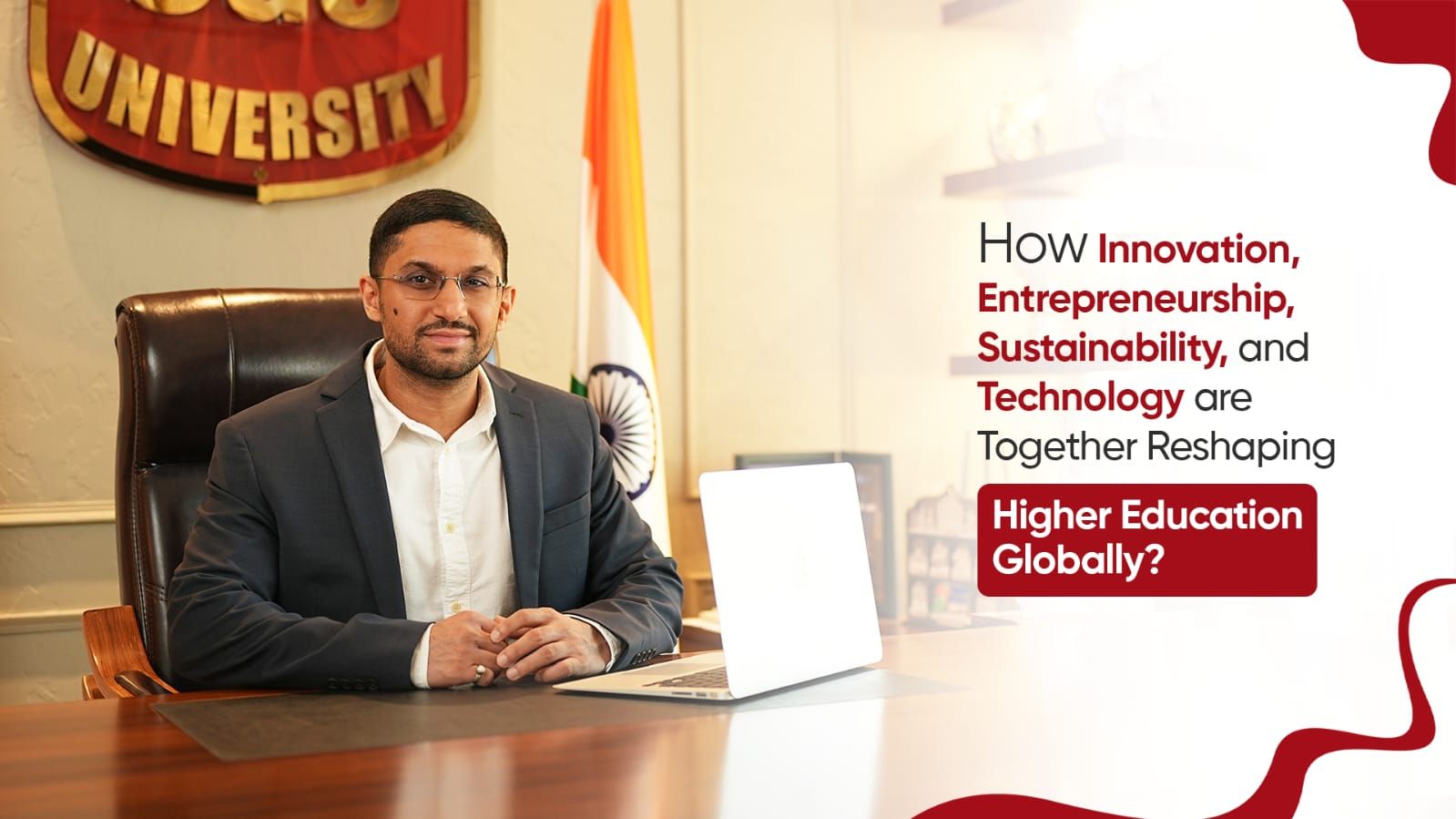
The outlook on Indian education institutions has historically suffered from a rather rigid reputation. However, thanks to changing global demands, we are now witnessing the emergence of an unprecedented era. This refers to how technological advancements, climate change, and a new-look business template means that Indian universities must adopt an approach rooted in applied learning, continuous progression, and of course, responsible global impact. As a result, we are now witnessing a wide-scale implantation of next-generation initiatives, designed to make your learning smarter and more innovative, all while cultivating sustainability at every touchpoint. Having referred to the dominating trends of today’s academic reality, it’s time for us to dissect them on an individual level, beginning from technology.
Once deployed as a supplement to traditional methods of teaching, technology has been officially elevated to run the entire show. For better understanding, an estimated 80% of students are already leveraging GenAI to enhance outcomes across a variety of academics tasks, with over 25% of teachers using it frequently or very frequently in their day-to-day operations. Talk about the ways in which GenAI is being used throughout education, the use cases include the introduction of AI tutors, capable of accommodating individual strengths and weaknesses, as well as offering real-time feedback. On teachers’ end, the technology is paying dividends by automating time-consuming tasks like grading papers, generating quizzes, and drafting lesson plans. Such a smart setup, like you can guess, goes a long distance to help the faculty focus more on guiding students in an effective manner. Apart from GenAI, the education sector is also betting on the power of immersive learning to unlock improved comprehension and retention, Here, we are encountering a more extensive use of solutions like Virtual Reality (VR) and Augmented Reality (AR) that are being positioned to use simulation for facilitating smarter learning in domains like health sciences, engineering, computer applications, management, and more. Another way through which technology is reshaping higher education relates to the introduction cutting-edge teaching aids like visual aids, audio aids, audio-visual aids, as well as kinaesthetic and tactile aids. At CGC University, Mohali, we recognize the unparalleled value of technology. Hence, we provide our students with AI-driven innovation hubs, smart simulation centers, and fully-automated workshop facilities that ensure job readiness among students, while simultaneously preparing them for placement across Fortune 500 companies. Not just that, CGC University, Mohali also hands you access to proven corporate-led digital frameworks, developed by the likes of EY India, IBM, KPMG, Capgemini, OS-SCI, and more.
Branching out of technology would be present-day education sector’s commitment to innovation. A representation of innovation in education is associated, let’s say, with outcomes-based education. You see, more and more institutions are now collaborating with real-world corporate houses to conduct meaningful upskilling drives. Complementing that would be the growing prevalence of micro-credentials, digital badges, and competency-centric learning, geared towards helping professionals intentionally enhance their skillset in trending domains like AI, Data Science, Cloud Computing, Renewable Energy and more. Beyond that, the innovation undertones in academics also show up big time when we touch upon the introduction of multidisciplinary education which integrates components like technology, traditional insights, and industry best practices to conceive holistic education at scale. In order to sustain this promise of innovation, CGC University, Mohali, allows students to participate in a variety of exercises like hackathons, well-equipped to supercharge your potential. We even offer students an industry-best Research & Development ecosystem, which has played a vital role in the development of over 2,600+ filed patents. Our research wing has even supported the publication of a staggering 2,800+ research papers, an effort underlined by an annual R&D budget of 15 Cr.
We now must turn our turn attention towards an important byproduct of innovation i.e. Entrepreneurship. Gone are the days when entrepreneurship, as a concept, was strictly associated with the management of a typical business venture. Instead, the modern age has reinvigorated it to focus more on idea generation and value creation. The pivot in question has spelled the birth of many critical startups within the global economy, including OpenAI, Anthropic, Uber, Stripe, and Cursor etc. The trend has also made its way to the Indian market, birthing plenty of powerful brands like Zomato, Flipkart Zoho, Ola and PhonePe etc. If anything, Indian universities are poised to double down on this entrepreneurial wave through specialized incubator and accelerator programs. Across these programs, aspirants will be able to avail seed funding and direct mentorship in the context of launching both commercial and social ventures. In that respect, CGC University, Mohali, has coined an ingenious VentureNest program. VentureNest was essentially devised to help students enjoy cutting-edge infrastructure, personalized mentorship from industry experts, strong networking opportunities, and comprehensive funding from India’s most esteemed capital investment firms.
In case that wasn’t enough, the program also delivers customized legal support, and therefore, sets the tone to achieve a robust governance, risk management, and compliance posture. VentureNest’s efficacy in what it does can be understood upon considering the fact it it has, thus far, incubated well over 100+ startups, empowering them to raise seven figure funding rounds. The initiative’s impact has an aspect of social welfare and equity too. as double-digit women-led startups have already benefitted from its resources.
On that note, we reach the final pillar of our agenda today and that is sustainability. Like entrepreneurship, once a peripheral idea, sustainability has also gained substantial amount of pace in recent times. We get to say so because of how global universities are actively using solutions, such as IoT, smart energy equipment, and predictive analytics, to optimize energy consumption and minimize environmental waste. Alongside that, the stated institutions are also combining ecological responsibility with venture creation to teach circular economy principles and systems thinking. For sustainability, CGC University, Mohali, has notably led the creation of various conservation projects that all strive to preserve our environment in one way or the other. Our institution further has in place a dedicated GreenPanther club, best-known for conducting powerful plantation drives and imparting the required knowledge to formulate a greener reality.
On a larger note, it can be claimed that the next phase of global education stratosphere will formally mark our departure from the traditional definition of learning, propelling the world towards early exposure to real-world business fundamentals, paid internships, and a corporate-led experience. Placing humongous emphasis on sustainability, this next era will also call for responsible progression in every single dimension. Of course, the entire push will draw a lot from our entrepreneurial approach, making it absolutely necessary for global education institutions to stay watchful and adapt according to the circumstances.