
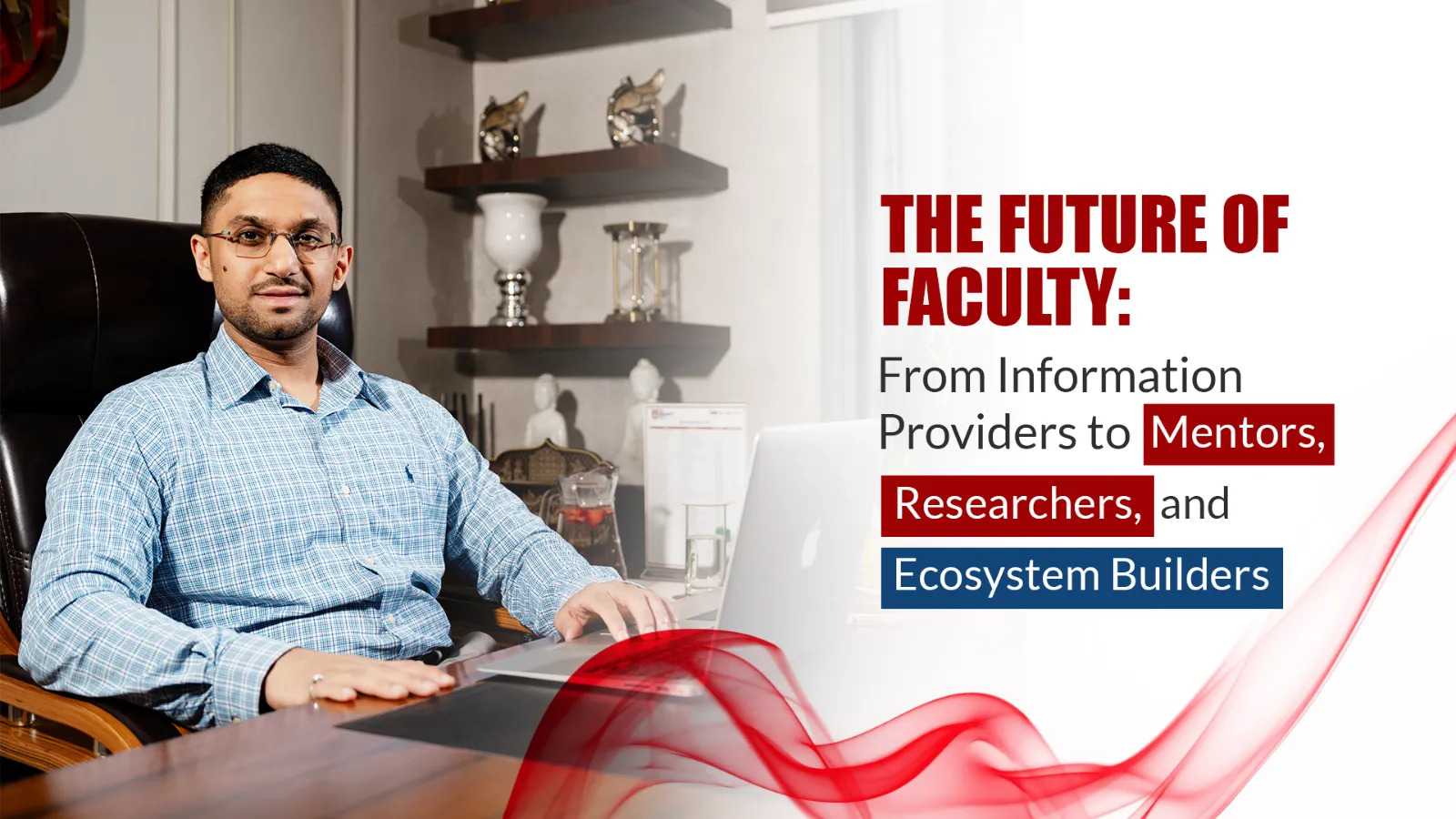
The template for a faculty member has historically been the one of information provider, who absorbs, combines, and delivers all the relevant insights at your disposal. Now, while this approach seemed to have produced results for decades, the underlying reality has now started to demand a tectonic shift. You see, with technology taking a smarter shape by the day, information sources that were once deemed scarce are now well past the point of being abundant. An example relaying the same relates to how AI’s emergence has greatly democratized information across a variety of domains, causing faculty members to rethink their identity, and, therefore, embrace the role of a guide focused on helping you effectively harness the available information. Expanding upon that change in their identity, these teachers must figure out how to shed all limitations and eventually grow into the archetypes of a mentor, researcher, as well as an ecosystem builder.
Talk about these different identities, we begin from the role of a mentor, an aspect where teachers can, for starters, empower students to navigate academic, professional and personal development. Here, the process involves identifying individual potential rather than forcing students to stick to any pre-defined concept and stifling their progress over time. This switch can walk a long distance to improve core learning experiences, but at the same time, the said approach can also open the gates for customized soft skill development. Hence, assuming someone has a commendable problem-solving instinct but lack the communication nuance, they can specifically work on it and overcome their hesitation. Apart from that, these mentors can even play an important part when the agenda is introducing students to suitable internships, competitions, and professional networks. This they can do while simultaneously giving aspirants greater clarity about career possibilities, industry expectations, higher education pathways, and other nascent opportunities.
At CGC University, Mohali, we recognize the value of expert-grade mentorship, a fact fully-evident across our top-notch faculty which hails from the world’s most prestigious institutions. Our line-up of professors/mentors work with young students on a granular level to let the latter understand emerging topics like Artificial Intelligence, Machine Learning, Data Science, Robotics, Cloud Computing, Blockchain Technology, Cybersecurity, and more.
Moving on to how faculty of today can transform into researchers, the answer includes departing from knowledge consumption to knowledge creation. In order to achieve that, teachers now must participate in research, capable of contributing new and unprecedented knowledge to their respective disciplines. Not just that, these faculty members can also put-together a whole new perspective by driving student involvement in research papers, experiments, surveys, and field studies, thus unlocking a whole new dimension in the context of higher education. Another detail worth a mention here is rooted in the still-untapped value of interdisciplinary thinking. Challenging the long-held ideology of living and dying by a particular niche, faculty members showcasing a clear allegiance to interdisciplinary thinking will have clear pathway to collaborate with their counterparts from a different category. Such a move should, like you can guess, should lay the foundation for more complete ideas, and as a result, instigate a holistic brand of growth throughout the next generation.
In case that didn’t suffice, global universities, and their faculty members, can also explore the prospect of industry-relevant research. Backed by in-depth business insights, these drives are much better positioned to capture the crux of a problem and address it in a sustainable manner. If we look past that, a separate, and more effective, strategy could be establishing a deeply-ingrained research culture. We say so because, when you have a research-rich environments running the show, students have a far bigger room to question the historical concepts, present their own two cents on the given proposition, and ultimately, steer the world towards its next big discovery.
Aligning ourselves with that very culture, we, at CGC University, Mohali, operate a dedicated research wing, which enjoys over 50 smart, fully AI-integrated labs that transform the otherwise tiresome research process into a simpler and straightforward version. The research legacy at CGC can also be understood once you take into account our annual research budget of 15 Cr. Thanks to that, we have successfully managed, so far, to file for 2,600+ patents. Hold on, there is more. CGC University, Mohali, has even facilitated the publication of 2, 800+ research papers till date.
On that cue, we transition towards the third biggest pillar of our discussion today i.e. how present-day faculty members can actually evolve themselves into genuine ecosystem builders for the future. Bringing the profiles of a mentor and researcher on the same wavelength, these ecosystem builders will bear the responsibility of connecting aspirants to established researchers, international lab centres, and other such platforms. Furthermore, the future of education will create an onus for teachers to build devoted student clubs and professional communities with shared interests, facilitating smooth and intentional knowledge transfer. This movement of insights can also be taken up a notch through robust alumni networks that allow current students an honest peek into life after college in terms of placements and other related elements. Having referred to placements, a separate, yet equally fundamental, task of an ecosystem builder will be to instil an entrepreneurial ability across the upcoming crop of students. As for how they can realize it, the faculty members can help students turn ideas into future-driven projects, intuitive prototypes, purposeful startups, and innovations strong enough to improve societal dynamics under one capacity or the other.
CGC University, Mohali’s recognizes the need of packaging excellence placements with entrepreneurial ambitions. From placement packages as high as 1 Cr. to real funding drives for budding entrepreneurs, we provide an experience which caters to every student and every dream.
Now, we covered what all the faculty members can do to become suitable torchbearers, but what we haven’t touched upon yet revolves around how universities, on their part, can support the stated evolution. This exercise, before anything else, must prioritize a constant investment in faculty development, including training the members on emerging technologies and industry best practices. Universities across the board also need to rework the way they measure faculty performance, something they can achieve by ditching the obsolete metric of teaching hours and recalibrating themselves to an impact-oriented definition for performance. Keeping up with that, education institutions should even put a system in place to reward innovative measures, such as the use of new teaching methods and technologies. Beyond that, universities markedly owe their faculty members refined and easy-to-comprehend administrative machinery, freeing up time for the latter to mentor students and generate enhanced outcomes.
At CGC University, Mohali, we believe in breaking the mould. This is a big reason why our institution has consistently made an effort upskill every faculty, regardless of their professional focus or background. The entire push is, of course, is directed towards fulfilling a vision i.e. creating a network of experts who can meet students right in the middle.
To sum it all up, it can be safely said that the advent of advanced tech solutions isn’t about replacing teachers. Instead, it is inclined towards taking the academic space to a qualitative reality, where faculty members can oversee students’ development on mental, and more importantly, emotional level. After all, by pledging to this holistic viewpoint, they’ll have a much better chance at bestowing the world with well-rounded individuals, well-equipped to become the leaders of tomorrow.